Visual feedback · agent-ready
Pin feedback to any website.
Your AI agent does the rest.
Clients click, type, save. You get a structured report — CSS selectors, computed styles, replacement text — that a coding agent acts on without a clarification round-trip.
The problem
01Feedback that costs more to understand than to fix
"The thing on the left is kind of weird."
That message lands in Slack, attached to a cropped screenshot with a red circle drawn in Preview. Now begins the real work: 20–30 minutes of back-and-forth — which element? which page? which viewport? which device? — before touching a line of code for a change that takes five minutes.
Multiply by twelve notes per session, three clients per month. The feedback loop is where small web projects lose days.
Developers spend more time translating feedback than executing it. That changes when feedback arrives pre-structured for a machine.
How it works
02Four gestures. Done.
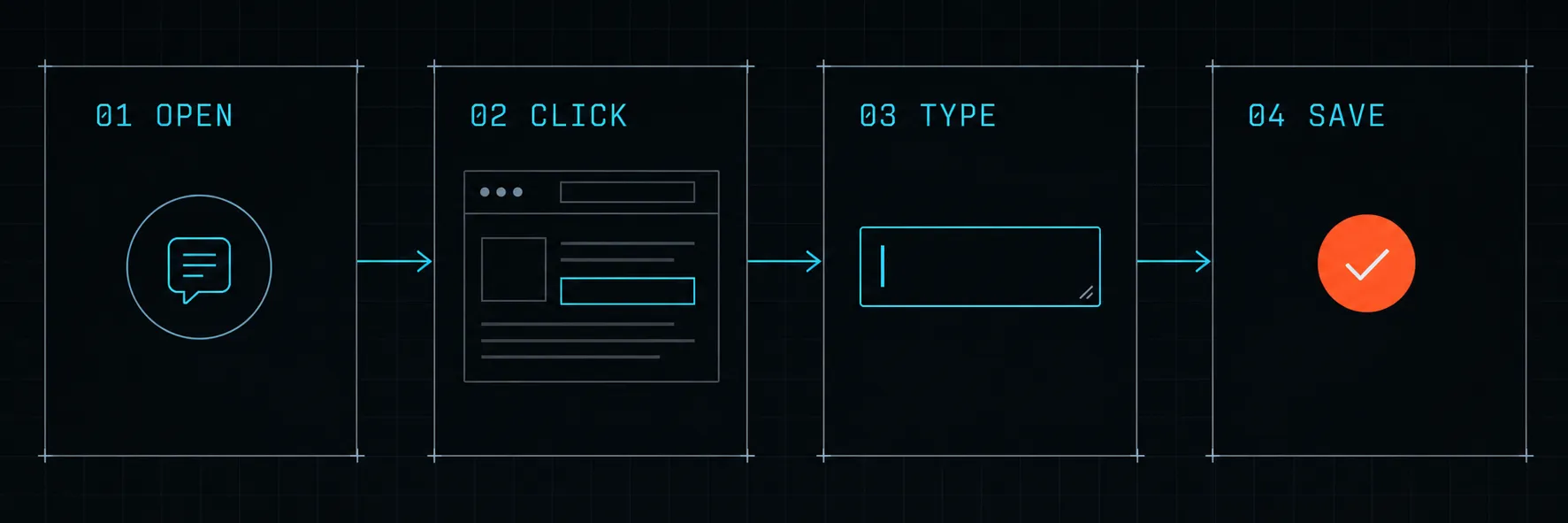
A non-technical client can leave a precise, machine-actionable note in under 60 seconds — with zero instruction. That is the hard requirement.
-
Open the widget
The reviewer visits the activation link —
yoursite.com?tellus=reviewer@email.com. A small launcher appears. One click enters feedback mode. A session cookie persists across page navigations for 24 hours. -
Click any element
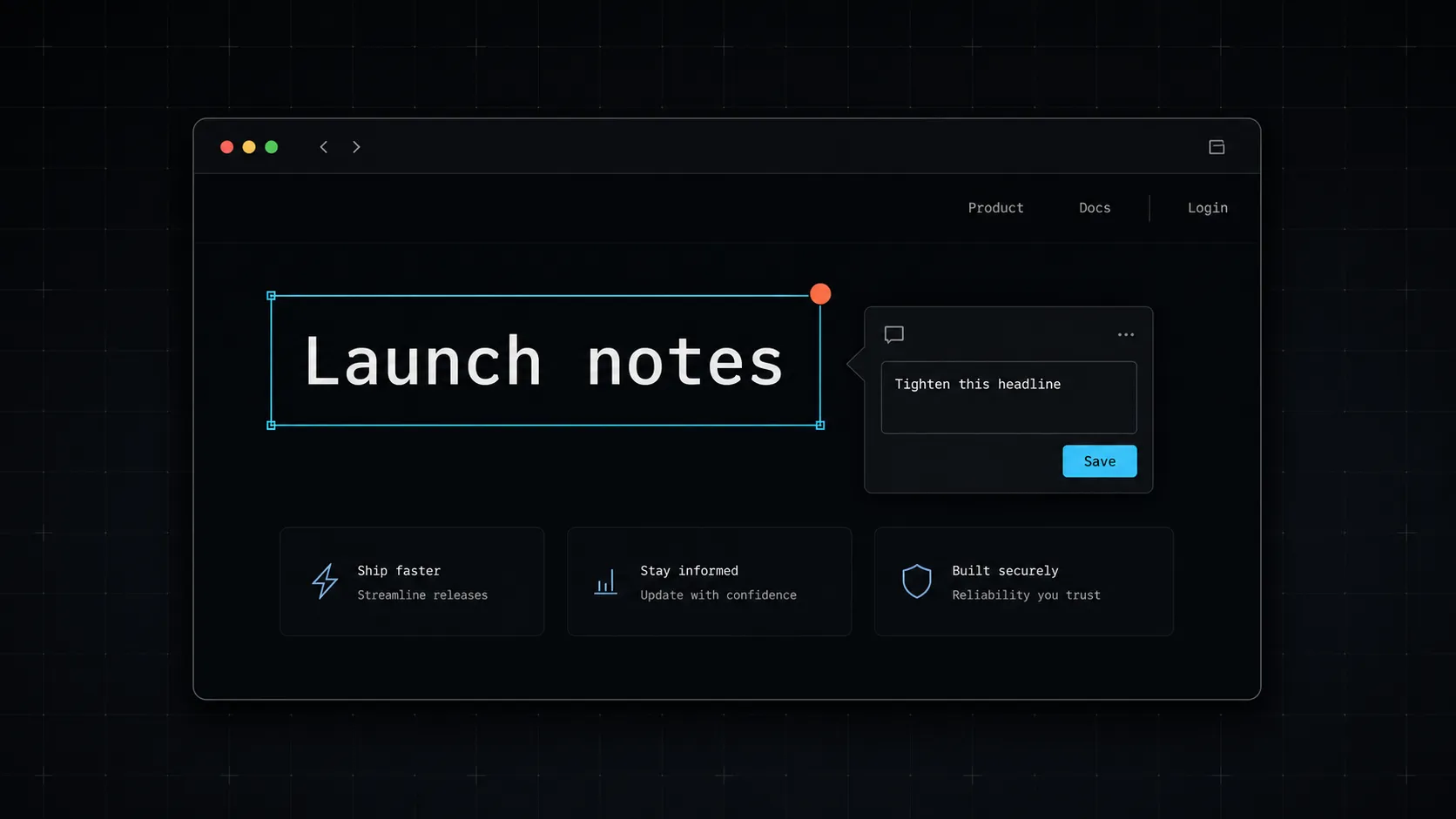
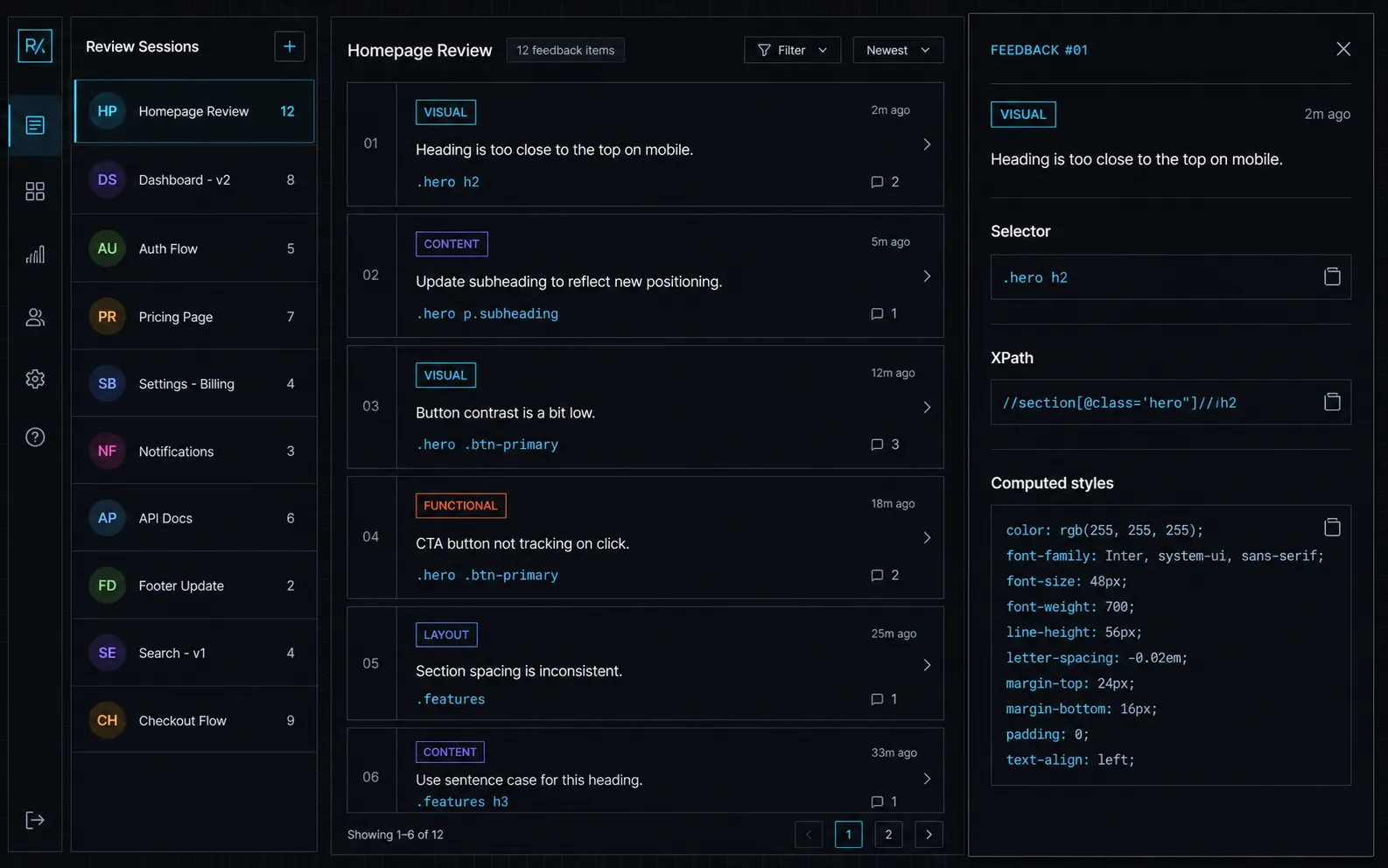
Every element highlights on hover — headings, images, nav links, buttons, anything in the DOM. Click to anchor the note. TellUs captures the element's selector, XPath, text, computed styles, and bounding box automatically.
-
Type the feedback
A small comment box appears anchored to the element. Plain language: "make this the studio's actual name" or "this feels too small on mobile." Screenshot and voice are each one optional extra click — never required.
-
Save
One button. An orange indicator dot marks the element. The note is submitted. The reviewer continues to the next page — no re-activating, no re-logging-in.
?tellus=offdeactivates the widget.
The embed script is entirely dormant for normal visitors. No DOM injection, no event listeners, no network calls — until ?tellus= appears in the URL. One script tag, no performance cost.
Why it's different
03Feedback built for the agent, not the inbox
Every other feedback tool captures what a human sees: a screenshot with a red circle, a thread of replies to untangle. TellUs captures what a coding agent needs — structured anchors and current state.
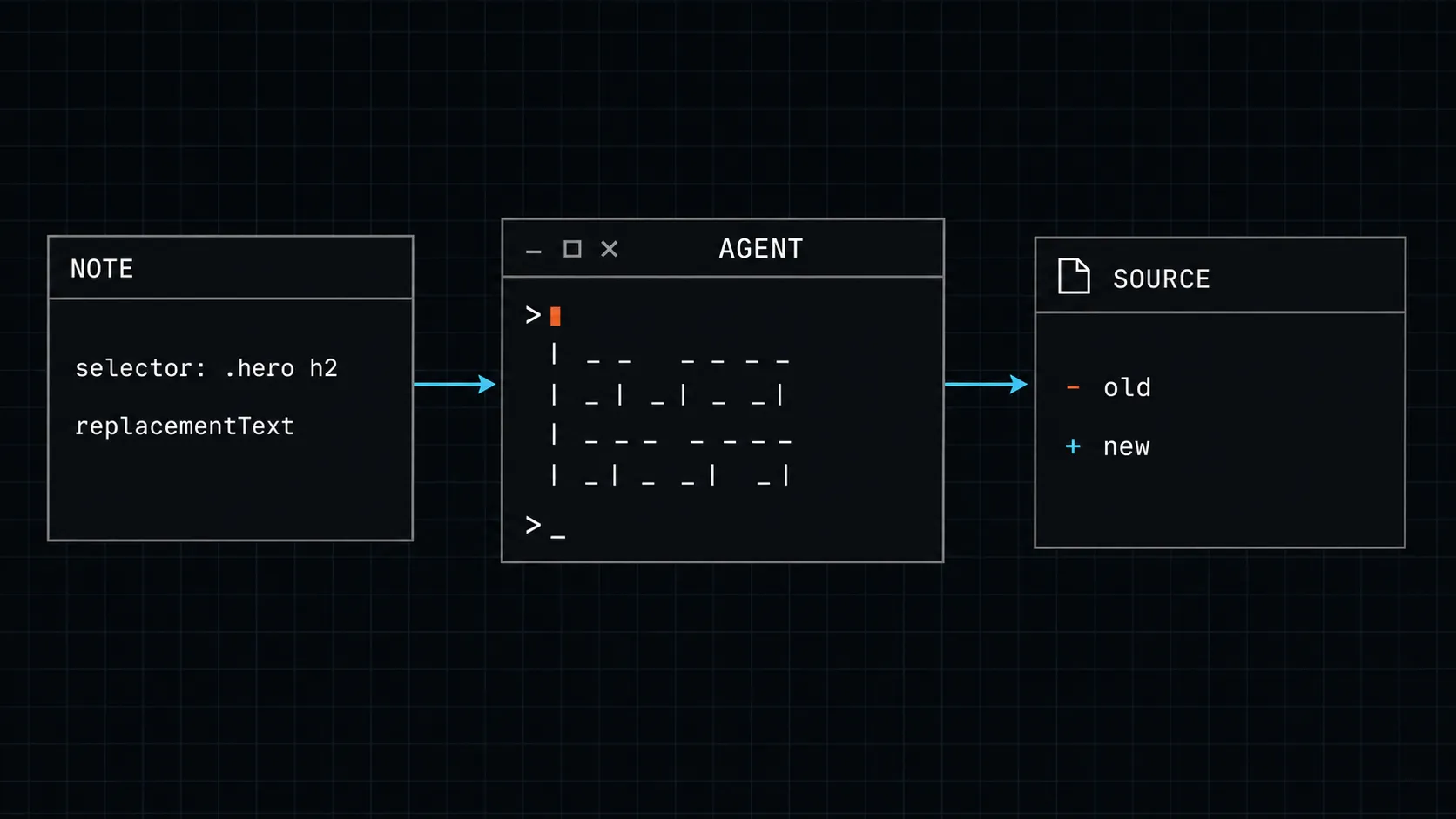
When a client says "make this heading bigger," the note doesn't just say that. It contains the CSS selector, the current font size from computed styles, the XPath, and the page URL. An agent locates the element in source and executes the change in one pass.
The summary report delivers a task batch in Layer 1 (~250 bytes/note). An agent acts on most notes without ever touching Layer 2. When it needs to disambiguate — three .price elements on a page — it fetches the detail layer: XPath, bounding box, screenshot, voice transcript.
{
  "site": "example.com",
  "session": {
    "reviewer": "Jan Smith",
    "device": "desktop / Chrome / macOS",
    "viewport": "1440×900"
  },
  "notes": [
    {
      "id": "note-uuid-001",
      "page": "/about",
      "selector": ".hero-section h2",
      "currentText": "Welcome to Our Site",
      "comment": "Change to our actual studio name",
      "replacementText": "Smith Creative Studio",
      "type": "text-change",
      "detailRef": "note-uuid-001"
    }
  ]
}~250 bytes per note. An agent reads the batch and executes. Most notes never require the detail layer — which preserves context window for the work itself.
What's included
04Every tier ships today.
Tiers 0–2 are production-ready. Tier 3 is roadmap. No waitlist, no gated beta.
01 · zero install
One script tag
Drop the embed on any site — WordPress, Wix, Webflow, Squarespace, static HTML, Next.js, Shopify, localhost. No framework dependency, no extension, no client account.
02 · activation
URL-driven sessions
Send a link: ?tellus=email@domain.com. The reviewer needs nothing else. A 24-hour session cookie keeps the widget active across page navigations. ?tellus=off ends it.
03 · data model
Two-layer reports
Layer 1 summary (~250 bytes/note) for agent task batches. Layer 2 detail — XPath, computed styles, bounding box, screenshot, voice transcript — queried per note only when needed.
04 · optional rich capture
Screenshot + voice
One extra click captures a focused screenshot of the annotated element. One extra click records a voice note, transcribed client-side where the browser supports it. Neither is ever required.
05 · MIT licensed
Self-hostable
Plain PHP + MySQL, no Composer, shared-hosting compatible. Set TELLUS_BASE_URL, run migrate.php, build the widget, deploy. Full guide in the repo.
06 · zero footprint
Invisible to visitors
The widget bundle is ≤25KB gzip. Core is ~10.5KB. Screenshot and voice chunks load only on first use. For every visitor without ?tellus=: no DOM injection, no listeners, no requests.
Vs. the alternatives
05Other tools capture feedback.
TellUs structures it for execution.
BugHerd, Marker.io, Feedbucket — good products, $39–150/month, per-client SaaS subscriptions. Their reports are designed to be read by a human who then translates feedback into code changes. That translation step is the bottleneck.
TellUs eliminates the translation step. The structured report goes directly to a coding agent. The agent has selectors, current state, and replacement text. It doesn't interpret. It executes.
| Human-readable SaaS | TellUs | |
|---|---|---|
| Report consumer | Developer reads, translates | AI agent executes directly |
| Clarification step | Usually required | Near-zero for most notes |
| Per-client cost | $39–150/mo subscription | Self-hosted, MIT licensed |
| Platform requirement | Varies; often WordPress-only | Any site, any stack |
| Client account | Usually required | None — URL activation only |
| Selector in report | Rarely | Always — primary agent target |
Get started
06Add one tag.
Send one link.
TellUs is live at tellus.alchemygraphics.com. Self-hosting is documented and straightforward. No signup page, no pricing table — get in touch or drop the snippet and go.
Step 1 — embed (one-time per site)
<!-- No API key. Trusted by origin allow-list. -->
<script defer
  src="https://tellus.alchemygraphics.com/widget/dist/tellus.min.js"
></script>

<!-- Self-hosted? Point to your instance: -->
<!-- data-tellus-api="https://your-host/api" -->
Step 2 — send the activation link
# Paste this in a message to your reviewer:
https://yoursite.com?tellus=reviewer@email.com

# The email becomes the notification target.
# ?tellus=off deactivates the widget.
# Session stays active 24h across page navigations.
Step 3 — get the report
# Layer 1 summary — agent task batch
GET /api/reports/{domain}/summary?status=open

# Layer 2 detail — one note, full context
GET /api/reports/{domain}/detail/{noteId}

# CLI (SSH on your server)
php api/cli/feedback.php example.com
php api/cli/feedback.php example.com --resolve note-id \
  --comment "Fixed in commit abc123"